
||Home ||About us ||Oil & Gas ||Mineral Industry
||Machinery Equipment ||Projects ||Our Services ||Contacts
|
||Home ||About us ||Oil & Gas ||Mineral Industry ||Machinery Equipment ||Projects ||Our Services ||Contacts
|
 |
|||
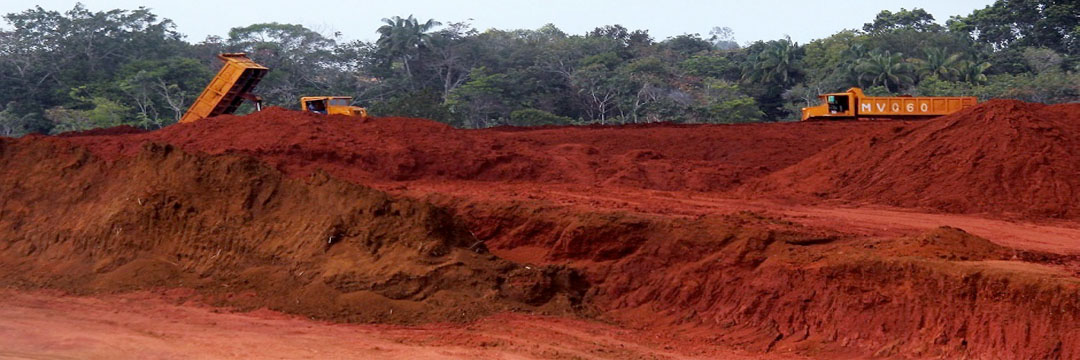
Bauxite ore is the world’s primary source of aluminum. The ore must first be chemically processed to produce alumina (aluminum oxide). Alumina is then smelted using an electrolysis process to produce pure aluminum metal. Bauxite is typically found in topsoil located in various tropical and subtropical regions. The ore is acquired through environmentally responsible strip-mining operations. Bauxite reserves are most plentiful in Africa, Oceania, South America and South Asia. Reserves are projected to last for centuries. Mining bauxite Production and reserves
Processing Usually, bauxite ore is heated in a pressure vessel along with a sodium hydroxide solution at a temperature of 150 to 200 °C. At these temperatures, the aluminum is dissolved as sodium aluminate (the Bayer process). The aluminum compounds in the bauxite may be present as gibbsite (Al (OH)3), boehmite(AlOOH) or diaspore(AlOOH); the different forms of the aluminium component will dictate the extraction conditions. The undissolved waste, bauxite tailings, after the aluminium compounds are extracted contains iron oxides, silica, calcia, titania and some un-reacted alumina. After separation of the residue by filtering, pure gibbsite is precipitated when the liquid is cooled, and then seeded with fine-grained aluminium hydroxide. The gibbsite is usually converted into aluminium oxide, Al2O3, by heating in rotary kilns or fluid flash calciners to a temperature in excess of 1000oC. This aluminium oxide is dissolved at a temperature of about 960 °C (1,760 °F) in molten cryolite. Next, this molten substance can yield metallic aluminium by passing an electric current through it in the process of electrolysis, which is called the Hall–Héroult process, named after its American and French discoverers. |
|
||
©2002-2024Black Gold Diggers Ltd.