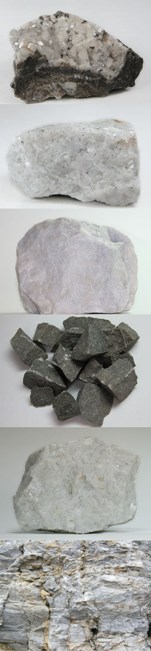
Dolomite is a common rock-forming mineral. It is a calcium magnesium
carbonate with a chemical composition of CaMg(CO3)2. It is the primary
component of the sedimentary rock known as dolostone and the metamorphic
rock known asdolomitic marble. Limestone that contains some dolomite is
known as dolomitic limestone.
Dolomite is rarely found in modern sedimentary environments but dolostones
are very common in the rock record. They can be geographically extensive and
hundreds to thousands of feet thick. Most rocks that are rich in dolomite were
originally deposited as calcium carbonate muds that were postdepositionally
altered by magnesium-rich pore water to form dolomite.
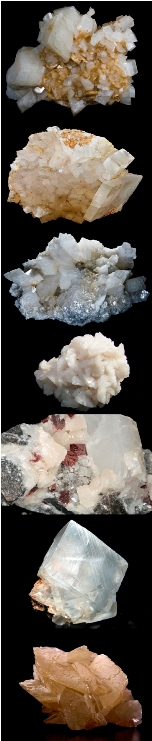
Dolomite is also a common mineral in hydrothermal veins. There it is often
associated with barite, fluorite, pyrite, chalcopyrite,galena or sphalerite. In
these veins it often occurs as rhombohedral crystals which sometimes have
curved faces.
Physical Properties of Dolomite
The physical properties of dolomite that are useful for identification are
presented in the table below. Dolomite has three directions of perfect cleavage.
This may not be evident when the dolomite is fine grained. However, when it is
coarsely crystalline the cleavage angles can easily be observed with a hand
lens. Dolomite has a Mohs hardness of 3 1/2 to 4 and is sometimes found in
rhombohedral crystals with curved faces. Dolomite produces a very weak
reaction to cold, dilute hydrochloric acid; however, if the acid is warm or if the
dolomite is powdered a much stronger acid reaction will be observed.
(Powdered dolomite can easily be produced by scratching it on a streak plate.).
Dolomite is very similar to the mineral calcite. Calcite is composed of calcium
carbonate (CaCO3) while dolomite is a calcium magnesium carbonate
(CaMg(CO3)2). These two minerals are one of the most common pairs to
present a mineral identification challenge in the field or classroom.
The best way to tell these minerals apart is to consider their hardness and acid
reaction. Calcite has a hardness of 3 while dolomite is slightly harder at 3 1/2 to
4. Calcite is also strongly reactive with cold hydrochloric acid, while dolomite
will effervesce weakly with cold hydrochloric acid.
Solid Solution and Substitution
Dolomite occurs in a solid solution series with ankerite (CaFe(CO3)2). When
small amounts of iron are present the dolomite has a yellowish to brownish
color. Dolomite and ankerite are isostructural.
Kutnahorite (CaMn(CO3)2) also occurs in solid solution with dolomite. When
small amounts of manganese are present the dolomite will be colored in shades
of pink. Kutnahorite and dolomite are isostructural.
Uses of Dolomite?
Dolomite as a mineral has very few uses. However, dolostone has an enormous
number of uses because it occurs in deposits that are large enough to mine.
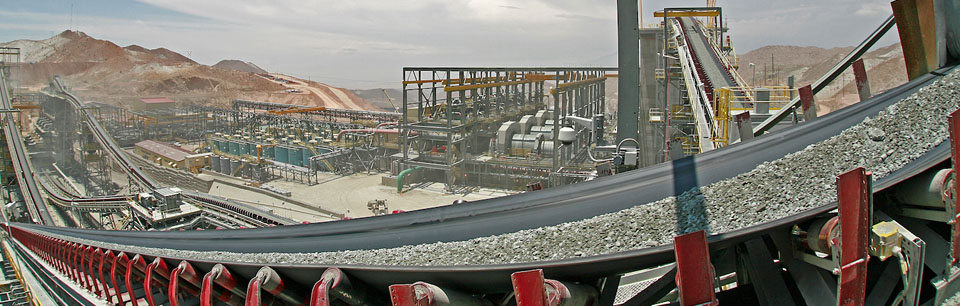
The most common use for dolostone is in the construction industry. It is crushed
and sized for use as a road base material, an aggregate in concrete and asphalt,
railroad ballast, rip-rap or fill. It is also calcined in the production of cement
and cut into blocks of specific size known as "dimension stone".
Dolomite's reaction with acid also makes it useful. It is used for acid
neutralization in the chemical industry, in stream restoration projects and as a
soil conditioner.
Dolomite is used as a source of magnesia (MgO), a feed additive for livestock, a
sintering agent and flux in metal processing and as an ingredient in the
production of glass, bricks and ceramics.
Dolomite serves as the host rock for many lead, zinc and copperdeposits. These
deposits form when hot, acidic hydrothermal solutions move upward from
depth through a fracture system that encounters a dolomitic rock unit. These
solutions react with the dolomite which causes a drop in pH that triggers the
precipitation of metals from solution.
Dolomite also serves as an oil and gas reservoir rock. During the conversion of
calcite to dolomite a volume reduction occurs. This can produce pore spaces in
the rock that can be filled with oil or natural gas that migrate in as they are
released from other rock units. This makes the dolomite a reservoir rock and a
target of oil and gas drilling.
Chemical Analysis Dolomite (Raw & Calcined) PDF
|